

You want flexibility, better work-life balance, and the freedom to work from anywhere. You're not alone. Millions of professionals are actively working to transition career to remote roles, and the path is more accessible than it has ever been. But wanting remote work and actually landing it are two different things. The process requires honest self-assessment, targeted job searching, a workspace that supports focus, and a mindset built for independence. This guide walks you through every stage of that process, from identifying the right remote roles to thriving once you're hired.
Table of Contents
- Key takeaways
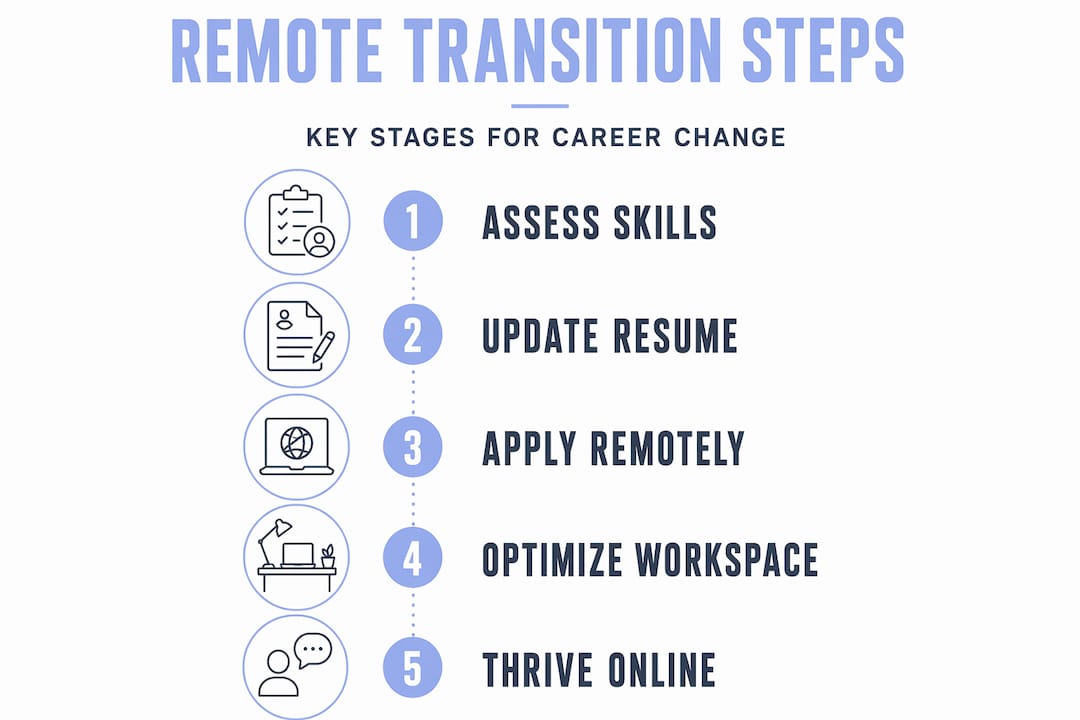
- How to transition career to remote: start with your skills
- Preparing your workspace and mindset
- Searching and applying for remote positions
- Thriving in your remote role after you're hired
- Evaluating your remote work fit over time
- My honest take on remote career transitions
- Find your next remote role faster
- FAQ
Key takeaways
| Point | Details |
|---|---|
| Map your transferable skills | Identify communication, self-management, and tech skills that translate directly to remote roles. |
| Set up your environment first | A dedicated workspace and clear daily boundaries prevent overwork and burnout from day one. |
| Target specialized job boards | Generic job sites miss thousands of remote listings; use platforms built specifically for remote roles. |
| Async communication is the core skill | Written updates and documentation-first habits are what all-remote teams value most. |
| Evaluate your fit regularly | Check in with yourself after 30, 60, and 90 days to catch problems before they become burnout. |
How to transition career to remote: start with your skills
Before you update your resume or browse job boards, you need an honest inventory of what you bring to a remote role. The good news is that most professional skills transfer. The question is whether you can perform them without the scaffolding of an office.
The three skills that matter most in any remote work transition are written communication, self-management, and tech literacy. Written communication covers everything from clear Slack messages to well-structured project updates. Self-management means you can prioritize your own work, meet deadlines without a manager watching, and recognize when you're stuck before it becomes a problem. Tech literacy doesn't mean you need to code. It means you're comfortable learning new tools quickly and troubleshooting basic issues on your own.
To find remote roles that match your background, start by listing your current responsibilities and asking which ones require physical presence. Most don't. A marketing manager, a financial analyst, a customer success rep, a recruiter, a software developer. All of these roles exist in fully remote form at hundreds of companies. Use that list to search for remote-specific job titles on boards that filter by location type.
- Communication skills: Emphasis on written, async formats like email, documentation, and project management tools
- Self-direction: Ability to set priorities and work independently without daily supervision
- Tech fluency: Comfort with video calls, cloud-based tools, and digital collaboration platforms
- Time management: Structuring your own day without external cues like office hours
Pro Tip: When updating your resume for a career change to remote jobs, add a dedicated "Remote Skills" section that lists tools like Slack, Notion, Asana, or Zoom alongside any experience with async workflows. Hiring managers at remote-first companies scan for these signals immediately.
Preparing your workspace and mindset
The physical setup matters more than most people expect. Remote workers often face difficulty separating home and work lives, which leads to overwork and isolation. A dedicated workspace, even a corner of a room with a door you can close, creates the psychological boundary that keeps work from bleeding into everything else.
Here's what a functional home office actually requires:
- A stable internet connection with a backup plan (mobile hotspot)
- A desk and chair that support good posture for long sessions
- Adequate lighting, ideally natural light or a quality desk lamp
- Noise management, whether that's a headset with noise cancellation or a quiet room
- A clear start and end time that you treat like a commute
The mindset shift is harder than the physical setup. Remote work forces you to take ownership of your schedule, your communication, and your emotional state in ways that office work doesn't. Isolation is real. Social connection must be intentionally created in remote environments because it won't emerge on its own the way it does in an office.
| Challenge | Office environment | Remote environment |
|---|---|---|
| Social connection | Happens organically | Must be scheduled deliberately |
| Work-life separation | Physical commute creates boundary | Requires intentional routines |
| Visibility to managers | Passive, presence-based | Active, output-based |
| Communication | Mostly synchronous, in-person | Mostly async, written |

One of the most practical strategies for combating isolation is the pair call. Buffer recommends 20 to 30 minute pair calls between teammates with no agenda other than connection. Schedule one per week and protect it. It's the remote equivalent of grabbing coffee with a colleague.
Pro Tip: Block the last 15 minutes of your workday as a "shutdown ritual." Review what you completed, write your priorities for tomorrow, then physically close your laptop. This signals to your brain that work is done, which is harder to do when your office is also your living room.
Searching and applying for remote positions
Making the switch to remote requires a different job search strategy than a traditional office search. Generic job boards surface remote listings, but they're buried under thousands of location-based results. Specialized platforms and databases built specifically for remote roles cut that noise significantly.
When you do find roles, your application needs to signal remote readiness from the first line. Hiring managers at remote-first companies aren't just evaluating your technical skills. They're asking whether you can communicate clearly in writing, manage your own time, and work without daily hand-holding.
| Traditional job search | Remote job search |
|---|---|
| Focus on local geography | Focus on company remote culture |
| Resume highlights in-person collaboration | Resume highlights async tools and written communication |
| Interview in person or by phone | Interview via video with technical or written assessments |
| Networking at local events | Networking in online communities and LinkedIn |
| Cover letter is often optional | Cover letter is a writing sample and is critical |
Your cover letter for a remote role is actually a demonstration of your written communication skills. Keep it concise, specific, and free of filler. Explain why you want to work remotely, what experience you have doing it (even informally), and how you handle async communication. Thousands of remote jobs are available across industries, but success depends on matching your skills to the role and making that match obvious in your application.
For remote interviews, prepare to discuss your home setup, your preferred communication style, and how you handle ambiguity. Expect behavioral questions like "Tell me about a time you worked independently on a complex project" or "How do you communicate progress to a team you rarely see in person?"
- Research the company's remote culture before the interview. Check if they have a public handbook or remote work policy.
- Prepare examples of written communication or documentation you've produced.
- Ask the interviewer how the team handles async communication and what tools they use daily.
- Clarify expectations around availability, meeting frequency, and response times.
Thriving in your remote role after you're hired
Getting hired is step one. Staying effective and healthy in a remote role is the real work. The most common reason remote transitions fail is that people try to replicate office culture remotely through back-to-back video calls and constant chat messages. GitLab warns directly against this, advocating instead for async workflows and durable documentation that anyone can reference at any time.
Mastering async communication means writing updates that don't require a follow-up question. It means documenting decisions so new teammates can get up to speed without a meeting. GitLab's handbook emphasizes a "single source of truth" approach where every important decision, process, and update lives in writing. This isn't just a company policy. It's a skill that makes you more valuable on any remote team.
Managing your workload without overworking is a separate challenge. Cornell ILR recommends pausing Slack notifications after hours and capping meeting lengths to protect mental health. Set those boundaries early in a new role, not after you've already burned out.
- Use a project management tool (Asana, Trello, Notion) to track your work visibly so managers don't need to check in constantly
- Write a weekly update every Friday summarizing what you completed and what's next
- Schedule one social call per week with a teammate that has no work agenda
- Set your status to "offline" at the end of your workday and stick to it
Pro Tip: Replace unnecessary status meetings with a written daily standup posted in your team's Slack channel. Three lines: what you did yesterday, what you're doing today, and any blockers. It keeps everyone informed without adding another video call to the calendar.
Evaluating your remote work fit over time
The benefits of remote work are real, but so are the challenges. Give yourself structured checkpoints to assess how the transition is going rather than waiting until you're overwhelmed.
- At 30 days: Are you meeting deadlines? Do you understand how your team communicates? Is your workspace functional?
- At 60 days: Are you maintaining social connections? Do you feel visible to your manager? Are you logging off at a reasonable time?
- At 90 days: Are you producing work you're proud of? Is the role sustainable? Do you feel connected to the company's goals?
If something isn't working, address it directly. Structured training and incremental ramp-ups yield better remote transition outcomes, especially for workers managing anxiety or depression. If isolation is the issue, add a weekly pair call. If overwork is the pattern, set a hard stop time and communicate it to your team. If you need formal accommodations, federal telework guidelines require individualized assessments to determine what support is reasonable.
Remote work is not a perfect solution for every person or every role. But for most professionals, the adjustment period is temporary. The skills you build during this transition compound over time.
My honest take on remote career transitions
I've worked with a lot of professionals making this shift, and the ones who struggle most aren't the ones with the worst home offices or the least technical experience. They're the ones who underestimate how much communication style drives everything in a remote environment.
In my experience, the biggest predictor of remote success isn't discipline or productivity. It's how clearly and proactively you communicate in writing. If you can write a message that answers the next three questions before they're asked, you will thrive. If you wait to be asked, you'll feel invisible, and your manager will feel anxious.
I've also seen people burn out not because they worked too much, but because they never felt like they could stop. The office has a built-in off switch. Remote work doesn't. You have to build that switch yourself, and you have to protect it even when the culture around you doesn't.
The mental health piece is real and worth taking seriously. Remote work can increase participation for people managing anxiety or depression, but only when the structure supports them. Don't wait until you're struggling to build routines. Build them on day one.
My honest advice: treat your remote work transition like a skill you're developing, not a destination you've arrived at. The professionals who do best are the ones who stay curious, ask for feedback early, and keep adjusting.
— Pamela
Find your next remote role faster
Making the switch to remote is much easier when you know exactly where to look. Most job seekers waste weeks on generic boards that bury remote listings under location-based results.
Remoteworkdatabase gives you direct access to over 1,200 company career pages, all filtered for remote hiring. Instead of sorting through thousands of irrelevant postings, you go straight to companies that are actively building remote teams. Whether you're just starting your search or ready to apply today, browse remote job listings to find roles matched to your background. Need help with the process itself? Remoteworkdatabase consultants are available to guide you through applications and do the heavy lifting when you need it. Check out the full range of tools and resources available to support your transition.
FAQ
What skills do I need to transition career to remote?
The most important skills for a remote work transition are written communication, self-management, and comfort with digital tools. Highlighting async-friendly experience on your resume significantly improves your chances with remote-first employers.
How do I find legitimate remote jobs during a career change?
Use specialized platforms and databases built for remote hiring rather than general job boards. Tailoring your resume and cover letter to emphasize remote-relevant skills gives your application a clear advantage.
How do I avoid burnout when working remotely?
Set a firm end time each day, pause work notifications after hours, and schedule intentional social interactions with teammates. Cornell ILR research recommends capping meeting lengths and protecting personal time as structural solutions, not just personal habits.
What is async communication and why does it matter for remote work?
Async communication means sharing updates in writing so teammates can respond on their own schedule rather than in real time. GitLab's handbook-first approach shows that mastering this skill is what separates high-performing remote workers from those who struggle.
How long does a remote work transition typically take?
Most professionals need 60 to 90 days to fully adjust to remote workflows, communication norms, and self-management routines. Structured ramp-ups with clear milestones make the adjustment faster and more sustainable.