

Remote work is no longer a crisis response or an employee perk. It's a deliberate business strategy. Understanding why companies hire remotely reveals something most leadership conversations miss: the real drivers are productivity gains, talent access, and retention outcomes, not worker convenience. 22.1% of employed Americans teleworked as of August 2025, proving that distributed work is a mainstream operating model. For HR leaders and executives evaluating their hiring strategy, the question isn't whether remote hiring works. It's whether your organization is using it strategically.
Table of Contents
- Key takeaways
- Why companies hire remotely: the real business case
- The talent pool advantage
- Business benefits that move the needle
- Building culture and operations for remote success
- Legal, compliance, and global scalability
- My take on why this matters more than most leaders realize
- How Remoteworkdatabase can support your remote hiring strategy
- FAQ
Key takeaways
| Point | Details |
|---|---|
| Talent access scales globally | Remote hiring removes geographic limits, letting companies recruit the best candidates regardless of location. |
| Productivity and retention improve | Studies link remote flexibility to measurable gains in output, engagement, and lower turnover costs. |
| Culture requires intentional design | Remote teams need structured onboarding, async processes, and regular sync time to stay cohesive. |
| Legal complexity is manageable | Employer of Record models let companies hire internationally without setting up costly local entities. |
| Strategy beats spontaneity | Companies that build remote hiring into their operating model outperform those treating it as an afterthought. |
Why companies hire remotely: the real business case
The most persistent misconception about remote hiring is that it exists to satisfy employee preferences. That framing misses the point entirely. Yes, 98% of surveyed workers favor hybrid or fully remote arrangements over fully in-person roles. But the reasons companies embrace remote work go well beyond keeping workers happy.
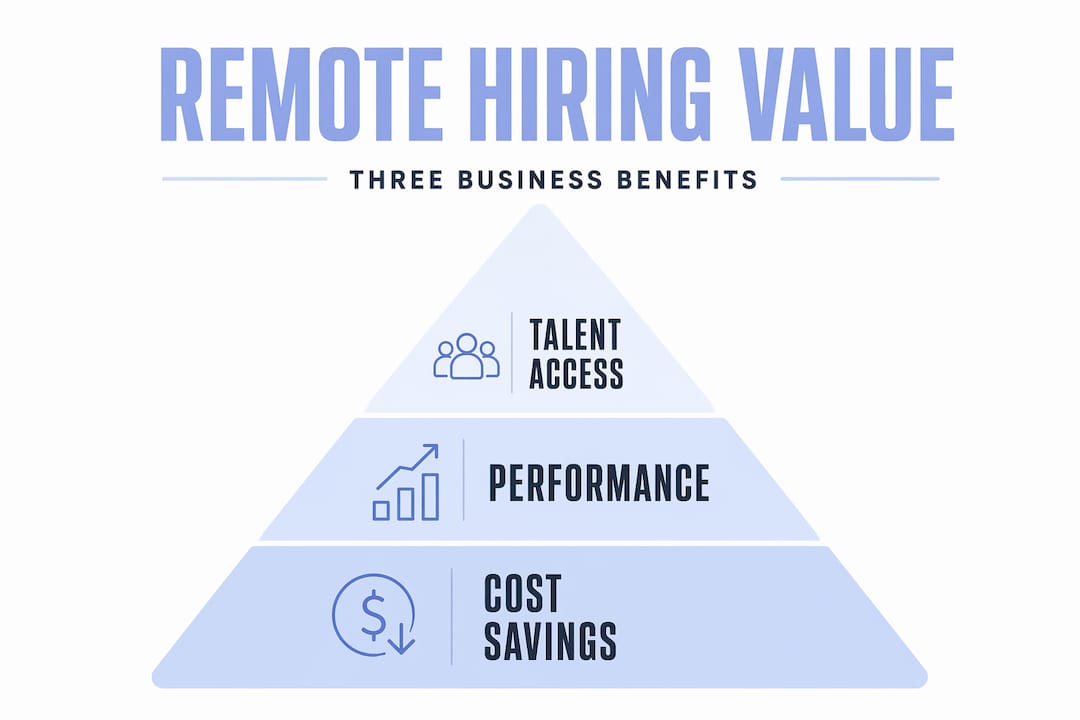
The business rationale breaks into three clear categories: access to better talent, measurable performance improvements, and cost efficiency. Each of these directly affects the bottom line in ways that justify the operational complexity remote hiring introduces. When leadership frames remote hiring as a talent strategy rather than a wellness benefit, the entire conversation shifts.
Consider what remote hiring actually solves. Local labor markets are finite. The supply of specialized engineers, data scientists, or senior finance professionals within a 30-mile radius of any given office is limited. Remote hiring eliminates that ceiling entirely. That's not a soft benefit. That's a structural competitive advantage.
The talent pool advantage
Geographic constraints are one of the most underappreciated bottlenecks in hiring. When a company restricts its search to candidates who live near its headquarters or are willing to relocate, it's competing for the same pool as every other employer in that city. Remote hiring changes that equation.
The benefits of remote hiring for talent access include:
- Access to specialized skills that don't exist in sufficient density in any single metro area
- Diversity gains from recruiting across different regions, backgrounds, and life experiences
- Reduced relocation friction that causes strong candidates to decline offers
- Faster time-to-hire when the candidate pool is ten times larger
Remote-first hiring solves talent shortages by widening the market beyond local and national boundaries, as Canadian firms have demonstrated by tapping global talent to prevent urban concentration of opportunity. This isn't a niche tactic. It's a response to a structural problem that no amount of office perks can fix.
The diversity angle deserves more attention than it typically gets. Remote hiring doesn't just expand the number of candidates. It expands the type of candidates. Professionals who are caregivers, people with disabilities that complicate commuting, or workers in lower-cost regions who've historically been priced out of high-cost job markets all become accessible. That's a genuine inclusion outcome, not a checkbox.
Pro Tip: When writing job descriptions for remote roles, explicitly state that the position is open to candidates nationwide. Vague language like "open to remote" still signals that local candidates are preferred.
Business benefits that move the needle
Here's where the conversation gets concrete. The advantages of remote teams aren't theoretical. They show up in retention data, productivity metrics, and operating budgets.
"Offering remote work expands access to broader, more diverse talent pools, improving productivity and retention." — FlexJobs expert, via CNBC
Dropbox is one of the clearest case studies available. After committing to a remote model, the company reported gains in recruiting, engagement, retention, and cost savings. That's not one benefit. That's a compounding set of outcomes that reinforce each other. Better recruiting leads to stronger hires. Stronger hires perform better. Better performance improves retention. Lower turnover reduces recruiting costs. The cycle is self-reinforcing.
The specific business benefits worth tracking include:
- Retention improvement: Remote flexibility is one of the top reasons employees stay. Replacing a mid-level employee typically costs 50 to 200 percent of their annual salary. Reducing turnover by even 10 percent has a significant dollar impact.
- Productivity gains: Remote workers often report fewer interruptions and more focused work time. The remote work productivity benefits are most pronounced in roles requiring deep concentration, such as software development, writing, and analysis.
- Real estate and overhead savings: Companies that reduce office footprint as part of a remote strategy can redirect significant capital toward headcount or product development.
- Faster hiring cycles: A larger candidate pool means positions get filled faster, reducing the productivity drag of open roles.
Pro Tip: Track your cost-per-hire and time-to-fill metrics separately for remote versus in-office roles. Most companies that do this discover remote hiring is faster and cheaper, which makes the business case internally far easier to defend.
Building culture and operations for remote success
Hiring remotely is the easy part. Building a company where remote employees actually thrive requires deliberate operational design. This is where many organizations underinvest, and it's why some remote hiring experiments fail despite strong initial results.

Dropbox's HR leadership has been direct about this: intentional operating design is necessary to compensate for the fewer natural moments of connection that in-office environments provide automatically. Water cooler conversations, spontaneous hallway feedback, and visible body language all disappear in a distributed setup. Companies that don't replace those touchpoints deliberately end up with disengaged teams.
Here's what effective remote operating design looks like in practice:
- Structured onboarding: New hires need a 30, 60, and 90-day plan that introduces them to colleagues, tools, culture, and expectations. Don't assume they'll absorb this organically.
- Asynchronous-first communication: Document decisions, meeting summaries, and project updates in writing. GitLab's entire operating model is built on this principle, making their distributed team of thousands function with minimal coordination overhead.
- Scheduled synchronous time: Weekly team calls, quarterly off-sites, and one-on-ones maintain the human connection that async tools can't fully replace.
- Clear documentation standards: Remote companies that scale successfully treat their internal documentation like a product. It's maintained, updated, and accessible.
- Explicit cultural norms: What gets celebrated? How is disagreement handled? Remote teams need these norms written down, not assumed.
Documented procedures for scalable decision-making are what separate remote companies that grow efficiently from those that collapse under coordination costs. The companies embracing remote work most successfully treat documentation as infrastructure, not bureaucracy.
Pro Tip: Schedule quarterly in-person off-sites even for fully remote teams. The research is consistent: face-to-face time accelerates trust in ways that video calls cannot replicate, and that trust pays dividends in remote collaboration for months afterward.
Legal, compliance, and global scalability
Hiring across state lines is manageable. Hiring across international borders introduces a different level of complexity, and it's the area where companies most often get into trouble.
| Approach | Best for | Key risk | Cost profile |
|---|---|---|---|
| Direct employment | Domestic hiring, established markets | Limited to local talent | Standard HR overhead |
| Independent contractors | Project work, short engagements | Misclassification liability | Low upfront, high risk |
| Employer of Record (EOR) | International hiring, new markets | Provider dependency | Mid-range, predictable |
| Local entity setup | Long-term, high-volume markets | High setup cost and time | Expensive upfront |
The Employer of Record model has become the standard solution for companies that want to hire internationally without opening local legal entities in every country. GitLab uses EOR to manage legal hiring across 65 or more countries, treating it as strategic infrastructure rather than a temporary workaround. When GitLab consolidated its EOR providers, it maintained 30+ critical hires in the first 30 days, demonstrating that compliance and hiring velocity are not in conflict when the model is set up correctly.
Beyond EOR, tax risk is a serious concern for global remote teams. OECD guidance recommends tracking employee work locations to manage permanent establishment risks, meaning a remote employee working from a country where your company has no legal presence could inadvertently create a taxable entity. This isn't a theoretical risk. It's one that tax authorities are actively enforcing.
Pro Tip: Before hiring internationally, build a simple tracking system that records where each remote employee performs their work. This takes 30 minutes to set up and can save your company from a permanent establishment audit years later.
My take on why this matters more than most leaders realize
I've watched companies approach remote hiring in two very different ways. The first group treats it as a concession, something they offer reluctantly to attract candidates who won't relocate. The second group treats it as a deliberate talent strategy, building their operating model around it from day one. The outcomes are not comparable.
What I've found is that the leaders who resist remote hiring most strongly are often the ones most attached to presence as a proxy for performance. That's a management habit, not a business principle. When you shift from measuring attendance to measuring output, something interesting happens: you start finding out who your actual performers are. That's uncomfortable for some organizations. It's also exactly the kind of clarity that high-growth companies need.
In my experience, the companies that get remote hiring right don't just post remote job listings. They redesign their feedback loops, their documentation practices, and their leadership development programs to work in a distributed context. The ones that skip that work end up with the worst of both worlds: remote employees who feel disconnected and managers who feel out of control.
The remote work statistics for 2026 show that CEO and worker preferences continue to diverge on return-to-office plans. That tension is real. But the companies that will win the talent competition over the next decade are the ones building the infrastructure to hire and retain distributed teams now, not the ones waiting for the debate to resolve itself.
My honest advice: stop asking whether remote hiring is right for your company. Start asking whether your company is built to make remote hiring work.
— Pamela
How Remoteworkdatabase can support your remote hiring strategy
Finding the right remote talent starts with knowing where to look. Remoteworkdatabase gives HR leaders and business decision-makers direct access to over 1,200 company career pages, making it significantly faster to identify organizations actively hiring remote workers nationwide. Whether you're benchmarking your own remote hiring practices or sourcing candidates from companies with proven distributed work models, the platform removes the research overhead that slows most hiring teams down.
For teams that need additional support, Remoteworkdatabase consultants are available to handle the manual work involved in building and managing a remote talent pipeline. If you're ready to put the benefits of remote hiring to work for your organization, explore the full suite of remote hiring tools available on the platform and see how much faster your next search can move.
FAQ
Why do companies hire remotely instead of requiring in-office work?
Companies hire remotely to access larger and more specialized talent pools, reduce overhead costs, and improve employee retention. These are measurable business outcomes, not just responses to employee preferences.
What are the biggest benefits of remote hiring for HR teams?
The primary benefits include faster time-to-hire from a larger candidate pool, lower cost-per-hire in many cases, and stronger retention rates that reduce the frequency of replacement searches.
How do companies maintain culture with remote employees?
Effective remote culture requires structured onboarding, written documentation of norms and decisions, regular one-on-ones, and periodic in-person gatherings. Companies like Dropbox and GitLab have built these practices into their operating models.
What legal risks come with hiring remote employees internationally?
The main risks include employee misclassification when using contractors, permanent establishment tax exposure, and non-compliance with local labor laws. Employer of Record services mitigate most of these risks without requiring a local entity.
Is remote work productivity higher than in-office productivity?
Research and company data, including from Dropbox and FlexJobs, consistently show that remote workers in focused roles report higher productivity. The gains are most significant in roles requiring deep, uninterrupted work.